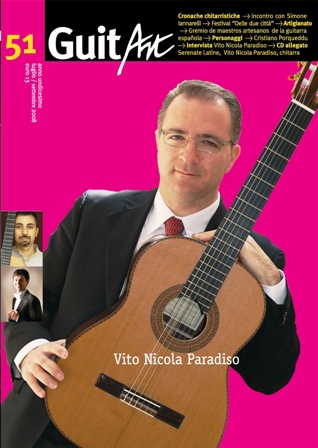
GuitArt
Interview with Vito Nicola Paradiso
The pleasure of learning to play… the guitar
A question immediately comes to mind, one that you must have been asked dozens of times: why did you decide to create your own method?
While fully recognising the value of and respecting the historic educational works already in existence, from my very first approach to teaching I felt the need to invent something new that would capture the students’ attention.
At the end of the 1980s, like many of my colleagues, I too began offering students the preludes and studies by Carulli, Giuliani, Sor and Carcassi, going as far as more modern methods such as Sagreras and Guitar Gradus. However, I noticed that the learning process, especially from a technical and practical point of view, was very slow; moreover, very few students followed it with consistency and interest.
At that point I found myself at a crossroads: should I continue with the so-called “Conservatoire” method, or move to the other side of the barricade, that is, to the simple accompaniment of little songs?
In the first case, I noticed the students’ disaffection, because they were forced to play a repertoire that, for their musical culture, was pedantic and boring; on the other hand, however, I did not want to diminish my role as a teacher with an approach based on four chords played with a plectrum.
I remember that, at that time, I often questioned myself as a teacher; I frequently asked myself one question: what did the student actually need? How could I make up for this gap with an easily accessible strategy that would also provide solid foundations?
Little by little, I began to develop other solutions and to experiment with different paths, using teaching units that were completely new compared with everything through which I, and many others like me, had received a so-called “classical” training.
I began inventing small pieces built around a gradual path and with clearly defined objectives.
First of all, there was the insurmountable obstacle of “solfeggio”, which for many students was a real torture. Reflecting on this, I immediately drew a comparison between musical language and spoken language, asking myself: does a child first learn to read and then to speak? So why, in music, must one first decode the entire notation and only afterwards produce sounds?
That was the moment when the method La Chitarra Volante was born.
Since you sell thousands of copies every year, what do you think were the winning ideas behind your method?
The intuition of having created a method that did not consider only the teacher’s needs, but above all those of the students. For the latter, moreover, the winning elements are the gradual progression and the topics, which are always dealt with in an essential way and in immediate language. For teachers, on the other hand, I believe the contents and the convenience of finding almost everything expressed in one book are predominant, without having to supplement it with photocopies, while at the same time finding plenty of material that can be used for student concerts and competitions.
Which age group is this educational path aimed at?
If we are speaking solely and exclusively about the educational aspect, the method is suitable for anyone approaching the study of the guitar for the first time; if, on the other hand, we also consider the graphic aspect, it is clearly a method for children and young people.
Before La Chitarra Volante, published in 1999, had you published anything else?
In ’94, I remember publishing a large 125-page book entitled “Basic method and practical introduction to the study of the guitar”, in which there was excellent gradual progression in the educational path. However, this too was overloaded with scales, exercises and, inevitably, the usual nineteenth-century studies.Metodo di base e avviamento pratico allo studio della chitarra” in cui c’era un ottima gradualità nel percorso didattico. Però anche questo sovrabbondava di scale, esercizi e, immancabilmente, dei soliti studi ottocenteschi.
In the guitar world of the time, I fondly remember the expressions of esteem from maestros and colleagues, as well as the positive reviews in the national press, but I noticed that those directly concerned, “that is, the students”, always remained somewhat detached, as if the language through which we related to one another was not the same.
In the meantime, I was already thinking of a project that would reinvent a new teaching strategy and adapt to the needs and requests of young people.
In those years I also published “Impressioni faunistiche”, a series of 12 studies for guitar inspired by the animal world. I noticed greater interest and more consistent commitment to study on the part of the students, with renewed enthusiasm in performing descriptive music.
Given the excellent results, in the same spirit I began to develop specific topics through engaging pieces which, at the same time, contributed to the student’s technical and musical growth.
After only a few weeks, I noticed, to my great surprise, immediate results, but above all the students’ interest grew day by day and, consequently, so did the commitment with which they applied themselves.
Everything was accompanied by a good amount of ensemble music, in which the students interacted with one another, overcoming all those initial difficulties with ease and enthusiasm.
In La Chitarra Volante there are several entirely new aspects compared with other methods. Specifically, what are they?
Yes! The innovations seen for the first time in a guitar method are numerous:
- the assessment tests, a very useful tool for teachers;
- the rifornimenti, which present elements of music theory in a more accessible way;
- the Minus-one CD, with backing tracks for the pieces, which allows the student first to listen to the piece and then to play it along with the backing track;
- the graphic aspect and the comic-style contextualisation of the two characters, who accompany the student on this imaginary musical journey around the world aboard the guitar.
I must say that, subsequently, publications by other “authors” came out which “used” these ideas in their books, without however achieving significant sales results, as they lacked planning and content.
Leafing through your books, apart from the beautiful drawings, I noticed that most of the pieces are your own compositions and very much reflect the ethnic character of the place by which they are inspired.
The drawings and graphics have always been handled by my friend Carlo Molinari, with whom I have been collaborating for several years.
Riguardo ai brani, tengo a precisare che non sono un compositore! Più che altro mi considero un autore di immagini musicali.
One of the musical genres I love most is descriptive music; indeed, I founded and conduct an orchestra that performs exclusively film music.
Furthermore, taken as a whole, the pieces included in my books are also a sort of lesson in geography and history, conveyed through the colours of ethnic music and different musical genres.
How is your educational path structured?
The method published by Curci is divided into three volumes.
The first book, with an accompanying minus-one CD, deals with the very first aspects of posture and hand position, knowledge of the instrument and an easy decoding of the notes, as well as including an anthology of solo pieces and ensemble music.
La Chitarra Volante 2, which has just been released in a second revised edition with two accompanying minus-one CDs, continues the same path as the first volume, with the addition of many new pieces that strengthen the gradual progression for each individual topic.
The third volume is an appendix to the method concerning accompaniments, extremely useful in music-curriculum courses, when the guitars playing in the orchestra have to compete, in terms of sound, with wind and percussion instruments.
Every one of your publications always includes an accompanying CD. Specifically, what is a minus-one?
In un libro di didattica, il supporto del CD audio è utilissimo in quanto dimezza i tempi di apprendimento e dà all’allievo l’opportunità di conoscere in anticipo il brano che andrà a studiare.
In an educational book, the support of an audio CD is extremely useful, as it halves learning times and gives the student the opportunity to become familiar in advance with the piece they are going to study.
Furthermore, with today’s computer technology, studying becomes easier even without extensive knowledge of IT. For audio, there are very simple programmes to use that allow the speed of the recorded piece to be slowed down or accelerated without changing the key. I can assure you that this too is an extremely useful tool that greatly fascinates young people.
After all, we live in the third millennium, and it is right to engage with and work with the new technologies available to us.
After all, we live in the third millennium, and it is only right to engage with and work with the new technologies available to us.
I know for certain that they have been adopted in several foreign schools, academies and universities. Through my MySpace page, I have been contacted by various teachers from France, Germany, Argentina, Serbia, Switzerland and the United States, where Maestro Ernesto Bitetti had them adopted in the pre-college programme at Indiana University.
“The pieces are all extremely pleasant and, in their skilful harmonisations and persuasive melodies, seem to echo something already heard yet always new, in such a way as to capture the students’ attention.”
With these words, a few years ago Piero Viti reviewed another of your publications in this same magazine: the “Latin American Dances” for two guitars. Was there a follow-up to this project?
I love Latin American music very much, and in this collection I wrote 12 dances that are a sort of homage to the great Maestros of Latin America, such as Piazzolla, Jobim, Gardel, Toquinho, Ramírez, Villa-Lobos and others. These are more complex pieces compared with the standard of the method, but I must say, to my great surprise, that second- and third-year students approach them with passion and achieve results that would have been unthinkable.
I am convinced that today’s young people, when properly stimulated, are able to become passionate and find both the interest and the time to devote themselves to study; one simply needs to give them the right tools to work with.
Al giorno d’oggi, i bambini e i giovani sono presi da tanti interessi e pertanto hanno bisogno di risultati e gratificazioni, altrimenti ciò che per loro inizialmente dovrebbe essere un divertente hobby da coltivare, rischia invece di diventare un susseguirsi di noiose lezioni di musica che spingono l’allievo al rifiuto e all’inevitabile abbandono.
It is the students themselves, in the first person, who want to create, manipulate and invent, rather than taking on only the role of passive interpreters. In all this, the teacher, and the method by which they are inspired, play a fundamental role in providing the input and the right essential notions so that the student can acquire autonomy and critical awareness.
I know that, in addition to the guitar, in recent years you have carried out various projects with young people. Would you like to tell us about them?
Having worked for over twenty years as a teacher in a music-curriculum school, apart from a few brief periods in a conservatoire, I have had the opportunity to devise new ideas and put them into practice.
In the 1990s I founded the Apulian Youth Guitar Orchestra, made up of my students, with whom we gave several concerts and recorded a fine CD of descriptive music. In 2000 came the Magnificent Christmas Show, a major Christmas production which, every year, involves more than 400 young people singing and playing together with internationally renowned guests. Three years ago, instead, I founded the Movie Orchestra, an orchestra of young singers and instrumentalists that performs exclusively film soundtracks.
I see that you do not have time to get bored, and what projects are in the pipeline for the future?
First of all, to continue playing, and then to keep proposing new things, new ideas both in publishing and in concert performance.
Seminars on new basic teaching methods aimed at young guitar teachers will soon be held throughout Italy.
In the publishing field, I have several ideas in mind, but time is needed to test them and put them in order.
In the short term, a series of booklets of original ensemble music pieces for guitar ensembles, with bass and small percussion ad libitum, will be published.
After this pleasant conversation, what advice do you feel you would give to young guitar teachers?
None at all! I can only bear witness to my own experience and place it at the service of the community; then everyone will choose their own personal path, with the awareness that they do not hold the truth in their pocket.
I believe that, living, as I said earlier, in the third millennium, we need to shake off stereotypes about music a little, and consequently stereotypes about music teaching.
In saying this, I do not want to be misunderstood, or perhaps accused of being transgressive or presumptuous. However, the reality that our young people experience today is very different from that of 20 or 30 years ago.
In my humble opinion, before the experimental music-curriculum courses in lower secondary schools were created — of which I believe I was a pioneer — conservatoires had somewhat lost themselves in figures who now belong to history.
For heaven’s sake! Figures whose merit in elevating the guitar to a noble instrument must be recognised, with a repertoire that is “debatably” of a high level when compared with Bach, Mozart and Beethoven.
So the only thing we can and must do as teachers is ask ourselves: who is the student today, and what are they looking for?
Not all students — of any musical instrument — will or must necessarily become concert performers or teachers in the future. In the overall education of the person, music is one of the components that helps one live better, feel good with others and become accustomed to appreciating the sense of beauty.
Therefore, the invitation I make to myself and to my colleagues is to make their students love music, accompanying them through paths that are congenial to them and, above all, relevant to the present day.