Seicorde
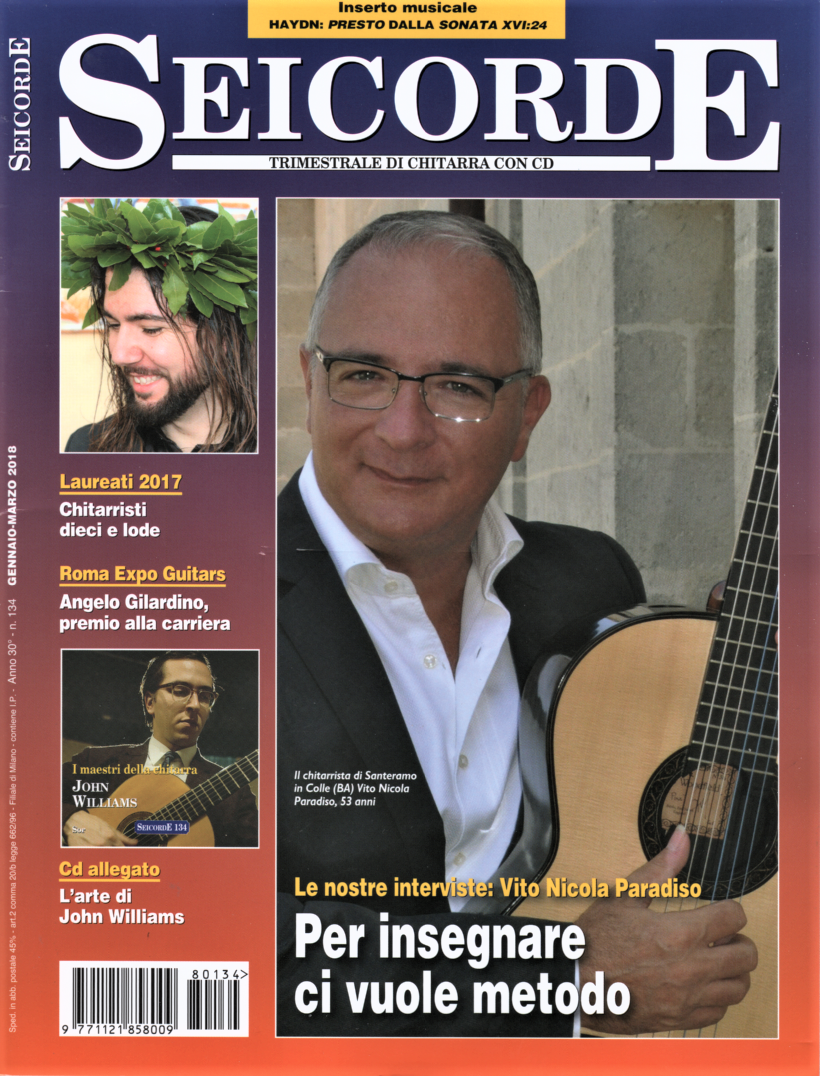
Interview with Vito Nicola Paradiso
«To learn, you need a method»
This is the firm belief of the 53-year-old Apulian educator and guitarist who, for twenty years, has won the trust of Italian teachers with his book La Chitarra Volante, a best-selling sales champion which, having just been translated into Portuguese and English, is now ready to conquer international markets. La chitarra volante, un best seller campione di vendite e che, appena tradotto in portoghese e in inglese, è pronto a conquistare i mercati internazionali.
A teacher at the “Bosco Netti” lower secondary school with a music curriculum in Santeramo in Colle, he has won the Golden Guitar Award for teaching and twice received the title of “Maestro of the Year”. Yet Paradiso has always remained attached to basic teaching: “I like starting a young person from scratch and instilling in them a passion for the guitar.”
by Filippo Michelangeli
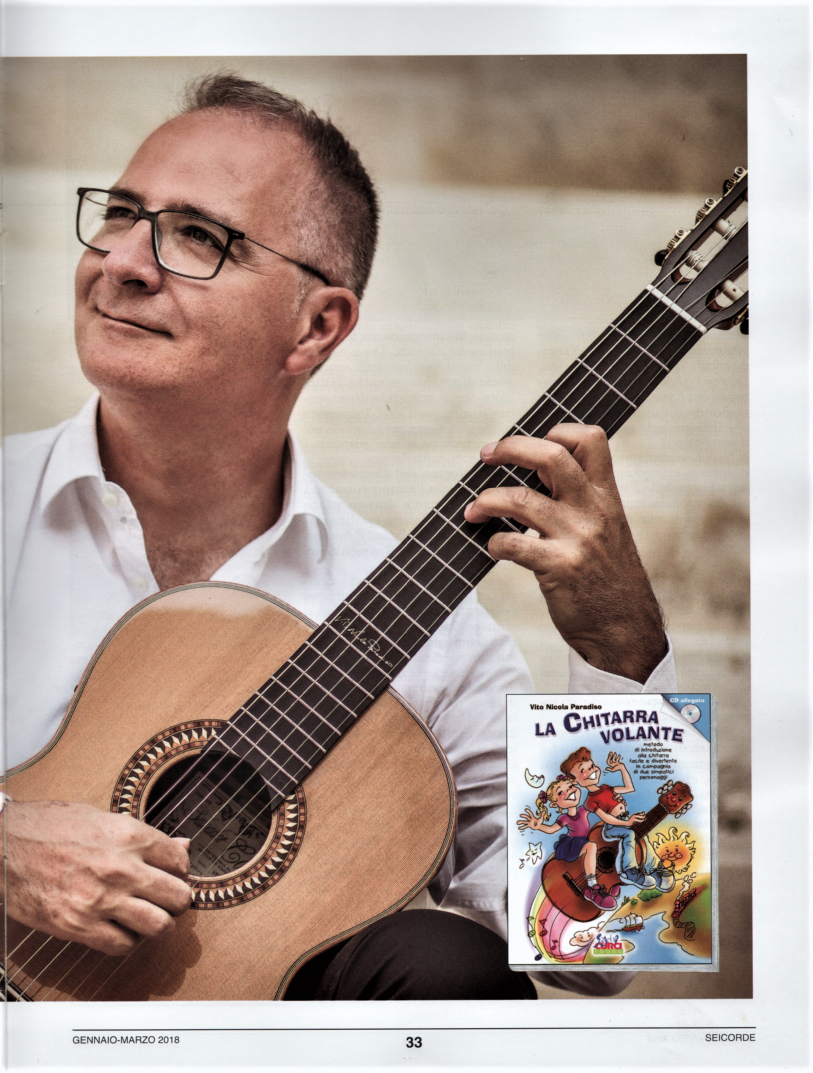
One man, one method. His celebrated introductory music text La Chitarra Volante — Edizioni Curci — has sold 230,000 copies in twenty years. A record number that testifies to the appreciation and trust that thousands of teachers throughout Italy have placed in him.
I am speaking of Vito Nicola Paradiso, 53, from Santeramo in Colle, in the province of Bari. An educator by vocation, Paradiso also carries out an intense activity as a composer and concert performer around the world, either as a soloist or in ensembles. He performs his own music and arrangements drawn from the vast repertoire of Neapolitan songs and Italian singer-songwriter music.
Success has not gone to his head. Even today, as international versions of his book are being released in Portuguese and English, and as he is continually invited all over the world to perform and to conduct guitar orchestras, Nicola Paradiso has remained the boy from Santeramo who loves the guitar and would like everyone to play it.
We meet him on the occasion of the 20th anniversary of his successful guitar method.
This year your book La Chitarra Volante celebrates its 20th anniversary. Congratulations! A publishing success that has accompanied the training of a generation of budding guitarists. What is the secret to creating a bestseller?
When it was released, it had strongly innovative elements, such as its graphic aspect and the gradual progression of the topics. The method is very progressive, and each new topic is explained in a very simple way. If a piece introduces the barré, it is explained beforehand. The assessment tests help the teacher understand whether the student has understood everything. It also includes a “minus one” CD with backing tracks and ensemble music pieces. At the time, it was a small revolution. In truth, it is a service method. My colleagues understood that, by using it, I would help them. Success came by placing myself at the service of teachers.
In 2015 it was translated into Portuguese by the publishing house Vitale in Rio de Janeiro, with the title O Violão Mágico. A great satisfaction, setting out to conquer Brazil, the homeland of Villa-Lobos, the composer who reinvented the guitar idiom of the twentieth century. Did you expect it?
I hoped so. I was convinced that sooner or later it would happen. Brazil has a great guitar tradition, and I am well aware of that. But now the English version is also about to be released, again by Curci, and we will go in search of our audience in England and the United States as well. I am very confident.
For some years now, there has also been a performance competition linked to the book and bearing the same name. It really seems that “La Chitarra Volante” has become your favourite brand…
Yes, I put my soul into this method; it contains all my passion for teaching and for young people. That is why, years ago, I also thought of creating an itinerant competition, which was very successful. This year I was overwhelmed by so many concerts abroad and skipped one edition. But in 2019 La Chitarra Volante Competition will return, more beautiful than ever!
How important is it to use a method in teaching music, and the guitar in particular?
Very important. Both for the teacher, who has a track on which to structure the work, and for the students, who know where they start from and where they will arrive. However, I want to say this clearly: the teacher, their professionalism, their passion, are irreplaceable. I am honoured that hundreds of colleagues use my book, but I know that a fundamental part of the work is done by them. And it really could not be otherwise.
Giuliani, Sor, Aguado, Carulli and then Tárrega, Sagreras, Carlevaro, Chiesa. Each of them wrote a method or collections of exercises and lessons for beginners. What were your points of reference as a young man?
Like many others, I began with Sagreras. But in that method, although it is much loved all over the world, there is not a perfect gradual progression. Sometimes one moves from one study to another with leaps that are difficult for students.
What age do you consider ideal for bringing a child closer to the guitar?
They should be seven or eight years old. Before that, it risks being a game.
In 2012 the International Guitar Conference in Alessandria awarded you the Golden Guitar Award for teaching; you were elected “Maestro of Italy” twice, in 2008 and 2012; and you have just received the Eurocorde Award in Mantua. Your career is studded with recognitions. When you began your activity, did you think you would go so far?
It is true, I have received many awards. In truth, I have always worked without belonging to any guitar school. I consider myself a free spirit. I have never been tied to a great maestro. Perhaps this made me freer to imagine a teaching approach detached from everything. I listened to everyone, I gathered advice from everyone, but in the end I always followed my own path.
You are very well known and appreciated as an educator, but in truth you also have an intense activity as a concert performer and as the conductor of large guitar orchestras. Where do you find the time to write books, teach, study and play?
You just have to organise yourself. I admit that playing comes very easily to me and, after having studied a great deal in my youth, I keep myself in shape without too many sacrifices.
Is there anyone in your family who has followed in your footsteps?
I have three children, Rocco, Mirco and Giannarita. All three studied music at school, but then they chose different professions.
Apart from the method, over the years you have published several original descriptive pieces, ranging from solo guitar to guitar orchestra: Preludi Sentimentali, La Chitarra Volante Ensemble, I Love Guitar, Travel in America, Danze Latino Americane and Impressioni Faunistiche. What do you say to those who claim that tonal language has had its day?
That is absolutely not true. The vast majority of people on the face of the Earth prefer listening to tonal music.
So the time has not yet come to “scrap” it?
For heaven’s sake. My goal is to bring as many people as possible closer to music and to the guitar. Tonal language is indispensable. When I travel around the world, I realise how much Italian music is loved everywhere. From opera to Neapolitan songs. Italian music is one of our most appreciated and strongest export products.
In your vast experience as an educator, often also in the very first stages of introduction, what idea have you formed of young people in relation to the classical guitar? How do you overcome the gap between what they listen to during the day and the need to make them study nineteenth-century works?
My method also serves this purpose. When young people reach the age of 12, they already have their own musical taste. And it is a taste absorbed from the mass media, which mostly provide pop music. We have to deal with this. It is important not to deny that world in front of them, but to integrate it with our classical tradition. After giving them good musical foundations, they are able to appreciate the nineteenth century as well. Without problems and without feeling different from others. That is why I included so much world music in my method, a “bridge” to unite the two worlds, pop and classical.
Next year the Conservatoire reform will celebrate its 20th anniversary, and it still encounters many difficulties in its application. What idea have you formed of it? Are you in favour of it, or do you regret the old system?
Let us say that both the old system and the reform have positive and negative aspects. What I miss about the old system is the opportunity to have a young person study an instrument for ten years with the same teacher, who could in this way truly set up a long-term path. The reform introduced the sacrosanct need to learn other subjects, but it took a great deal of time away from students for practising and today they jump from one course to another, sometimes neglecting the study of their main instrument.
After teaching for a lifetime in lower secondary schools, you arrived at the Conservatoires of Matera and Taranto, but then preferred to return to your first love. Why?
Because I like starting young people from scratch. Today I teach at the “Bosco Netti” lower secondary school in Santeramo in Colle, a stone’s throw from my home. I do it willingly; every year I invent different projects. I feel fulfilled.
But do your students understand that they are not dealing with just any teacher, but with a star?
Yes, come on, some of them realise it. But in the end I am there for them, to introduce them to music and make them passionate about the guitar. Everything else does not matter.
Travelling around the world, how do you find the situation of the guitar compared with 30 years ago? Is it more widespread and more integrated into the general musical world than it once was?
In the major concert seasons, the guitar is still seen very little. Perhaps a few decades ago there were Segovia and Díaz, who had managed to win the trust of promoters. Although today the general level of guitarists has risen a great deal, they often lack an element of originality that can attract the attention not only of colleagues, but above all of music lovers. I admit that, when I have the opportunity, in the evening I prefer listening to a concert of music that is not for guitar.
What is missing in the musical training of guitarists?
Making chamber music. The sense of time, phrasing and listening is learned above all by playing with others. That is why I have always devoted so much time to ensembles and guitar orchestras. After playing in a group, young people become more aware and more mature even when they play alone. It is a piece of advice I feel I can give to all colleagues: make your students play together.